Sunday, 20 January 2019

Star Wars Resistance: Episode 12 - ""Bibo"

Synopsis: Nekku makes friends with a smelly hungry creature which brings danger to the whole platform.

What I thought: I know what you're all thinking: this is a filler episode. Where's the First Order? Where's the season arc that we all got excited about in the mid-season trailer? Well, if that's what you're after, you'd not be liking this episode, but there's much more to this show than the overall Sequel Trilogy arc.

This was an entertaining episode. Sure, it was quite clear to see where the whole plot was going to end up as soon as the big creature turned up, but we got to see a lot of the mechanism and heart of the station, from the top boss, Captain Doza admiring Kaz's piloting skills, to the engineering section which reveals those two children from several episodes ago (Children from Tehar) have even more significance than before: the younger one is clearly force-sensitive. Was this why the First Order wanted them? Did they know this? Are they hunting down force-sensitive children much like the Emperor did?

Then there's the reference right near the start to The Clone Wars, in regard to the salved equipment that Synara trawled up. Name dropping like that is delightful. Also, great to see Synara back although still clearly conflicted as she's in league with the pirates still and potentially still assisting them although it's still highly possible she's looking for a route out and will eventually side with the platform crew.

Brilliant also to see the Aces out there. Fast they are becoming individually more interesting, especially the stormtrooper helmet pilot with the tie-esque fighter. We also get to see that Kaz is easily as skillful, if not more skillful, than the Aces.

Neeku and his smelly friend.

The children are back.

Octopus is on the menu.

Rating: 7/10 - Predictable, but enjoyable episode with Neeku in fine form throughout, and tidy pickings of extra information gleaned regarding the children.

Sunday, 13 January 2019

The Curse of Oak Island S06E01


We’re back and it’s a foggy wet day on Oak Island, much like my brain is clouded when it comes to remembering what happened last season; lots of digging, chatting in the War Room, money being spent and a cross as the big find? That’s about the gist of my failing memory. However, it’s great to be back, as we can look forward to how people with a lot of money can cause a lot of destruction in a relatively small space for little reward … for another season. This is TV entertainment folks!

Things get started with the obligatory air shot of Oak Island, which is a little foggy today, as Rick and Marty drive towards the island fresh with bags of money and plenty of ideas of how to make as much of a mess as possible. We’re reminded that this is a 50-year-old childhood dream for the brothers who are hoping that this year is the year that dreams come true: much like the last 5 seasons then. Marty says he’s only 70% convinced that something happened on Oak Island, which apparently is much more than he started with, which goes to show how someone with a lot of money can soon find them parted from the $$$$s.

OMG! There’s a new War Room! Apparently, tourists have been causing havoc so a new one has been established in a secluded spot, which you’d think wouldn’t be easy on such a small island. It’s still got the same sign on the outside though (EST. 2013) but hey, who cares about accurate dates on this island? Everyone is inside, like the knights of the round table, including Dan who has rarely left the house. Pleased to see Craig Tester is still there, despite what he said at end of last series. The big three are on the table, no, not Rick, Marty and Jim, but the targets for this year: the swamp, the money pit and Smith’s Cove. The latter involves the idea of a massive coffer dam so they can find that wooden structure underneath which they think are trapdoors. H8 in the money pit is also one of the 3 where they hope a series of multiple seismic analysis will finally reveal what’s below. This feels a little familiar when it comes to wanting to find out what lies below, aside from mud and water. Also on the table is having metal detector expert Gary spend the rest of his life scanning the island, starting with lots 1-8 and a few others never previously checked before. There’s excitement at nuking area of trees in order for Gary to wield his manly detector.

The next day and there’s a trip to the money pit to map those seismic tests. In comes a geophysical company to do the dirty work. First up, a test! Blimey, that’s a change. They have mapped up where they know a searcher shaft from mid 1800s (called Halifax Tunnel) is located. If this goes well, the brothers will feel more willing to spend one million dollars on having the whole area scanned.  A series of 2ft holes along that area are filled with dynamite and then detectors to pick up the vibrations: good vibrations one hopes. This literally is akin to blowing up money.

Marty and three of the team head to Smith’s Cove to see if the winter’s storm has washed anything up. Gary is out with his detector and … he finds a modern iron spike. Next up, they find some lead! Possibly from a ship, so the hype wagon drums up to us. They all seem super excited already.

It’s the first trip to the pub of the season, as some of the gang look over the lead speculating about it, including that maybe those who lost that cross on the cove lost the lead. Hmm, maybe. Or, maybe not. They want to get the lead tested to find out its original geological location. Which, partially in my mind, might be the off the back of a nearby fishing vessel.

Next day again, and the seismic test in the money pit is almost ready, but Gary and Rick head to Lot 2 which has been a little mutilated. Apparently, this is the first ever time this lot has been metal detected. First up, there’s a massive boulder covered in moss which they clear and find a signal near. They found a massive coin from 1797! Wowzers. Now this is actually something tangible. Very handy when they have dates on them huh? Doesn’t really answer much about the mystery of island but shows people were here and pretty careless with their money in the 1790s. It could show that there was a British presence not long after the discovery of the money pit in 1795.

At the Money Pit, the test line is almost ready as they detonate about 150 small charges that will be detected. Not all at once though but one by one. Next day in War Room they look over the results. This shows the a 2D layer cross section of the area that’s like a mosaic mess of colours, but they do show that Halifax tunnel in the results.

Next day and there’s a convoy onto the island as the seismic test team start preparing about 1,000 charges and detectors to create a 3D map of the ground beneath the entire money pit. It feels strange to detonate the ground although I assume it’s a muffled detonation that’s not very destructive.
Craig, Dave and Peter are on a car ride 300 miles NW to Fredericton to watch over a test of that lead cross from last season. At a university they will laser the cross and then get its isotope that’ll tell us roughly where it came from.

Back at Lot 2, Gary and Jack the destroyer are searching the forest undergrowth. There’s nothing at all to start of with but they zero in on another boulder and, hey presto, there’s something there that’s iron; literally on the top of it and a hole on the side. Definitely manmade but when and why? Gary thinks it might have been used to put a ring and rope around to help pull something along, maybe treasure?

Back at Fredericton and the chemical analysis is on its way. First up, there’s traces of hey ho silver in it which isn’t unusual due to a lack of techniques in the past to refine better. The next main revelation is that it’s not from North America. Let speculation begin! These results are later discussed in the War Room via a teleconference. There’s still a good chance it’s Templar related, not least because it looks very similar to their crosses. There’s talk of Europe specialists to call upon next. Is this another plane trip?

Back at Lot 2, Rick and Laird join to look at that boulder, and pull back more of the moss to reveal yet more drill holes. There’s also a small triangular shape chiselled onto the side of the stone. Is it a freemason mark? Or is it nothing in particular?

Next day and more charges are detonated in the Money Pit but in Smith’s Cove the guys bring in an EM61 metal detector equipment on wheels that can go much deeper than the handheld ones that Gary uses. Poor Gary must be feeling inferior right now.

Rick, Dave and Craig are on a road trip to Irving Company, who have been the people making those big massive holes in the money pit these past few years. These guys have some proposals on how to construct that dam at Smith’s Cove. By way of augmented reality, they show how it’ll look with two massive cranes helping to construct the dam. The guy wearing the headset was totally unnecessary really and timewasting, but it seems Rick and co see enough to cement the deal. No real surprise there then? Some companies only have to sneeze, and Rick is ready to wipe their noses.

Back at Smith’s Cove and the EM61 has trawled the area and locates something metallic in one area deep below the sand although there’s not much to say what it is.

Gary and Rick head to Lot 21 which has also been a little mutilated as well. This is where Daniel McGinnis used to live back in 1700s, whom we had his descendants visit last season and tell the story of a cross said to have been found by him. First up, an old hinge. Then … it’s another jewel/gem brooch of a red colour. Ohhhhhhh, it’s beautiful.

The Money Pit gets yet more destruction by way of dynamite.

This is the result of Money Pit tests ... yeah, It makes no sense to me either.

Oh, a 1797 beautiful coin!

And a broach ...

Rating 8/10 – A very decent start to the season with concrete plans, discoveries, and more money being spent than you can possibly imagine. It all looks very promising, but then, it always does at this early stage of a season doesn't it?

Saturday, 12 January 2019

Conversing about 'Citizen Curators' - Core Session 5

Believe it or not, we've arrived at the final core session before things go full-on project crazy up until the end of the programme. It's a trip back to Helston's 'Museum of Cornish Life' for us in the West Cluster of Citizen Curators, where there are more objects from all aspects of life than you can imagine ... and more. So much more than you'd think, that my imagination feels quite feeble when I'm within the walls of this museum.

Before getting to the subject matter of the hour, there was a recap on our conventions (an opportunity to guess amusing responses to the clues) and reminder about our log ... ooops. I'm totally failing on that aspect but at least I have a blog and my diary to help fill in the gaps when I get round to the log :)

Interpretation and (re)Presentation

We started with a trip back to the 1970s by way of John Berger's 'Ways of Seeing' TV series; particularly episode 1, 30 minutes of which is on youtube, which we were supposed to see before the session; I totally forgot. Thanks to Christmas and New Year, up until a few days ago, I thought the next Citizen Curators session was next week so my schedule was totally mixed up! Today we watched ~ 10 minutes of the episode, which provoked different views from those of us in the room: from those finding it absorbing, right up to disinteresting. For me, it had a rather psychedelic feel, much like everything in the 70s, and being a big fan of progressive-rock (which originated in the 70s) I really like that vibe and atmosphere that you get. He provoked thinking and did things in a surreal manner at times via the camera angles. Not everyone can watch old programmes and connect with them, but being a bit of a retro fan, and enjoying the mystery he created when talking about our perceptions of art, I found it strangely soothing and absorbing. When it comes to art, I'm much a "like what I see" person and less on the finer details, yet Berger's programme did make me think much more about the art itself, and how most art is taken out of its original contextual setting and reproduced amongst other paintings in galleries. Seems early art was mostly commissioned, and only ever destined for a specific room in a specific location. The lighting and other objects/colours in the room influenced the artist, yet all that it lost in reproductions and paintings being just one of many in a gallery. And yet, by having reproductions and paintings being plastered all over the internet, it actually encourages some people to physically go see them. Then there's the grandeur nature of museums when it comes to art and by having painting hung and positioned in certain ways, people immediately will believe a painting could be more magnificent than it is. I'm reminded of many a stories I've seen when non-displayed objects have accidentally fallen on floors in museums, such as someone's glasses or a pen, and you see tourists gathered around them as they believe that fallen object is a piece of art itself. All in all, Berger's programme certainly created an interesting debate within my mind and the group itself whilst watching the programme.

Storytelling

Thereafter we moved on to how objects on display can have different stories created about them, from the more scientific life story of the object, to any new or unexpected knowledge that might have been discovered that one can tell the audience. How can we make that object more relevant to the people viewing it? I've been in plenty of museums that don't even bother to make objects interesting, and simply just give the standard 'museum label' and info. i.e. a jug. The more simpler the object, perhaps the more inventive one needs to be. A jug is a jug after all, but who handled it? What was in it? What's it made of? Where was it found? Why should anyone care about this jug? There are of course objects that are fascinating to observe even with the simplest of descriptions present, but not everyone is going to lap up an object with a mundane label next to it. How to cater for all types of audience?

Group Task - Key Messages and Calls to Action

This mini-task was all about selecting an object and thinking about what it was about that object that you want the audience to know about it, and then look at how to help the audience interact with it by way of some form of action.

In my Penlee Museum group, we concentrated on the object that forms the basis of our upcoming project: Penlee House itself. What we wanted the audience to know is that this is a house that was lived in and hadn't always been a museum/gallery; that's our key message. In terms of calls to action, we would ask things like "Can you imagine what it was like to live in this house, as a servant, as one of the family?"

Moods & Meanings

Just before the lunch break we went through the numerous ways that information about objects can be presented the audience:

  • The Museum Label - Your bog-standard obligatory label next to an object that tells you what it is and, if you're lucky, a little more about it.
  • Punditry - As you might think, this is less about in the museum, but more about those critical "experts" who like to tell you what they think the object says and how you should think about it.
  • Personalisation - This is about bringing people into the object, much like those classic fairground displays where people put their heads through a gap in a display to make it look like they are somewhere else. Whether they get the right message about the object is debatable, but they go away with a memorable experience.
  • Poetic - There's been plenty of poems written about people and objects; perhaps something with a zangy rhyme to it or thought provoking verse can cast a certain perspective and view about an object..
  • Musical - Everyone likes a song - but by having music accompany an object, it can make it much more interesting and even have you tapping your feet or thinking more about it than if there was just a deathly silence.
  • Humours - A witty label? Animated painting anyone? Some think this is sacrilege but if you're bored or uninterested in a painting, and it winks or smiles at you, it certain gets your attention where it wouldn't have before.
Group Task - Words and Senses

In the afternoon there was another group task where once again we chose an object (we stayed with Penlee House) and picked a "sense" out of the glove and present the object in the manner of that senses interpretation. We got "picture" whereas another group got "Music". In this task, picture literally meant picture: so no words. However, as this was more about planning than performing, the plan of course featured lots of words. We came up with numerous ideas about having a nice old map or the area on display with pointers to where modern scenes fit into the old layout and having the windows of the house filled up with enlarged photos that show a view that people might have seen in yesteryear whilst looking into the house. 


Sunday, 23 December 2018

Star Wars Resistance: Episode 11 - "Station Theta Black"

Synopsis: Poe and Kaz go for a spin and discover an abandoned First Order facility that's not really that abandoned but actually about to be blown up.

My thoughts: It really feels like things are heating up and leading to some sort of climax. The Fireball is once again in action as Kaz borrows it to head out with Poe to meet General Leia! It didn't need Leia in it for Kaz to hand over the data he got from last week, but it was a nice touch. The most surprising thing to me was that there appears to be zero other people on the resistance ship! I know they are short on staff but I don't recall seeing anyone else! Although it was totally unnecessary, it was nice to tie-in the bigger resistance picture, make Kaz feel valued and to spice things up. I'm still unsure what Poe sees in Kaz, other than his flying skills, and why Kaz is so up for for being in the Resistance against a threat that's largely really unknown?

The scenery at the First Order station is amazing but I can't get it around my head that it would be left so abandoned? Why leave such an obvious physical base empty without any guard? Yes, there was a security system there which detected Poe/Kaz but why not bring the explosives to blow it up before you leave? Totally weird but super fun when Kaz/Poe get chased about and somehow manage to get away from every close encounter. Kaz is naturally totally ridiculous once more but pulls it off in a way Jar Jar Binks used to.

It seems the First Order were busy plundering resources from the area for weapons. No one believes that'll make much of a wave in the Senate, which makes one feel that they must still be quite thick in the senate or Snoke has just as much a hold over them as Palpatine did?

It's General Leia!

Not so abandoned after all, eh?

Kaz screams and falls all over the place but gets the job done.

Rating 7/10 - More Resistance context setup for us here and some enjoyable confrontation in what was beautiful scenery at the space station.


Friday, 21 December 2018

Conversing about 'Citizen Curators' - Core Session 4


Introduction

In what's been a total opposite of my feelings before the last session, time has really flown by this time between sessions. Aside from being kept busy with my volunteering, I've been ploughing ahead with my first draft of my AMA CPD Plan, with the second draft deadline early January. Naturally I'm trying to factor some of the Citizen Curators course into the CPD Plan which isn't as easy as I expected. I also attended an Ethics session since my last blog post, which I have written about but not posted ... yet.

Once again, as per my previous blog posts on Citizen Curator Core Sessions, these are my own thoughts and views from the day, thus they aren't comprehensive or definitive representations of what was covered and discussed. 

Citizen Curator Core Session 4 – Curators in the Community.

It's back to home base for me this time around, as we were situated at Penlee Art Gallery & Museum in the rather unique former cart shed outer building. Luckily there are heaters in this somewhat shell of a structure as well as the world's slowest cold water tap when it comes to filling the kettle. There were also less of us, for various reasons I didn't fully grasp, which made it somewhat cosy, especially as I was the only male this time. 

Things started off with the usual reminders - a task that is very useful for my rubbish brain function as I often need pointers to help jog the memory into action. Oh, coffee helps too, but pokes and prods really do jumpstart my brain into optimal functionality. We had a rather fun "Fill in the gaps" shout-out-the-answer task at the start to go through the Citizen Curators Values and Conventions. I could remember most of them thanks to the visual clues, of which the most important is to be an observer and to think critically. Thankfully for me, those conventions come naturally; I'm never afraid to ruffle feathers.

Thinking ahead to the upcoming group project, we were reminded to think a little about any training requirements one might require, who our digital colleague is (of which none of us were familiar with the Penlee one) and to arrange a meeting with Tehmina to go through the first high level project plan; this we have scheduled for next week.

There was an opportunity to do some verbal reflections of experiences since the last session. Naturally I drew a total blank in my brain; recall being a very weak component of my brain structure. Thankfully there were other people with much better memories than me, and we nattered about their thoughts on troubles in a local Cornish music group and their participation in the 'Empowering Women in Cornwall' Facebook group. It's always interesting to hear others views and thoughts on issues and how they've made some sense of those experiences.

This session, as with all sessions, has a quotation based around the session's theme, with this week's being connecting with communities and the social and economic barriers as well as preconceptions of museums. The cost of entry to museums is a barrier to many with the cost varying quite wildly. Solutions, such as free days or free entry with an emphasis on donations, is one way to get people in. We discussed how single-parents and unprivileged might find it harder to visit, not least the logistics but also costs: family tickets are usually for the classic 2.4 children families. We also talked about more staff training for dealing with disabilities, so they can recognise not just the obvious visual disabilities visitors might have but the unseen ones. Personally, I find staff are often trained but when it comes to putting things into practise, it's almost as if they never had the training. Perhaps more real-world training or on-going training is needed because there's nothing like real practise to really help people learn.

Diversity

Diversity was heavily brought up. One needs to create as many ways in to museums as possible and remove obstacles. It's not just the obvious here either such as the workforce and governance, but diversity is needed across many areas. What types of collection are on display? Do they represent the audience? Who visits? Just schools? Or are there just exhibitions? One needs to look at profiling the groups who visit and finding out who they are and then working out who isn't visiting. One needs to think 'Beyond the legal' - for example, transport isn't a protected characteristic in law, but can museums help provide transport for certain groups who aren't able to visit?

Cornwall

We had a discussion on Cornish recognition, of which I am a born and bred Cornishman. No no no, it wasn't a discussion about me but our minority status, much like the Welsh, for we have our own distinctiveness in customs, traditions and sports etc. Most of our museums are highly kitted out for tourism, especially as 70% of visits are by tourists but what about the locals? Most museums closed out of season. There's also a lot of deprived areas in our county. Is enough done to help the locals by museums? There are special reductions and/or passes for locals at some museums, but do enough know about it?

Knowing your museum's communities

There are numerous ways to find out about who visits your museum, from the obvious forms of physical and online surveys, to playing more attention to comments left in visitor books and comment cards. Some places are better than others at reading those and making any actions based on the feedback they get. Talking to people and finding out why they don't visit, watching and observing those who do visit, looking at TripAdvisor and Google reviews - all various ways of getting data. I myself have been looking at the Google Analytics of where I volunteer's website. There's a wealth of information there. Perhaps too much information but it can tell you how many visits you get, what days/hours, what pages are being visited, for how long, if people return to visit your site and demographics. I did report back on the information I obtained from the analytics, which did make for interesting listening although I am still unsure what difference that data made to anyone's general thoughts.

Access

We looked at access to museums which includes physical issues but also the more invisible ones such as dyslexia and most mental health illnesses. Surprisingly, 1 in 5 museum websites don't provide access information, which, along with how to get to somewhere, you'd think would be right up there with the obvious things to provide information about. This led into the afternoon's group task, in which our group looked at a specific area of the museum and the kinds of included and excluded groups that area catered for. Homing in on Gallery 5 of Penlee Museum, which is upstairs and a reasonable large room, it clearly caters for art lovers, especially those who loved local art, as that's the primary function of that gallery. There was also work from local adults and children. Who did it not cater for? Well, we didn't think there were a lot of options for parents who work the standard 9-5 job to get access into the museum, the lift had a weight limit and excluded those confined to mobility scooters. The solution to these problems were not easily solvable with the latter already having been looked at by the museum and would require extensive work. As for the former issue, we figured a series of after closing time events, for children, parents, or the elderly would help to fill in some gaps for excluded audiences.

Tuesday, 18 December 2018

Star Wars Resistance: Episode 10 - "Secrets and Holograms"

Synopsis: The First Order finally arrive ... for a chat with Captain Doza, whilst Kaz does his best to find out what it's all about.

My thoughts: It's a return to form for the charismatic Kaz who performs his full repertoire of comedy poses and expressions this episode. Quite frankly, he's totally OTT and ridiculous, but I have to say, highly entertaining. There's actually a lot of silliness to this episode, of which Torra, Captain Doza's daughter, seems to share the same genes as Kaz, as she's also too is hyperactive and easily excitable. Thankfully again, much like most characters on this show, she's very likeable. What I don't quite understand is why she continually sneaks out of her room and the tower but later when she "rescues" Kaz from her father's office, she chooses the trash compactor route for them to evade everyone? Bizzare. Naturally, I assume it's intended to link back to Rucklin's jump as some sort of glorified servant in the tower where he's emptying the trash from Doza's office. That can be the only reason, and of course the game simulator sub-sub-sub-plot of the episode, so they can do some crazy leaping and jumping about to evade the compactor's lasers. As enjoyable as it all is, especially to see a view that is so nostalgic to A New Hope, I can't help but worry about the efficiency rating for this compactor which seems to fire haphazardly at anything that moves, rather than the static trash that it's actually there to incinerate? Is it really this stupid or was this done for effect? I can only guess the latter.

Learning that Captain Doza was a former senior employee of the Empire really raises an eyebrow, although you just know that Kaz's assumption about what that means is going to be anything but accurate. Having also gained the data off the agreement form between Doza and the First Order, I'm wondering what that could possibly tell anyone that they don't know already? Most T&C stuff is really dry and hardly known for containing sensitive material. Hopefully we'll find out a little about that at least. Clearly one can tell from the conversation between Doza and the First Order that it's all a little sketchy on the finer details:

How many stormtroopers will be positioned on station? As many as needed.
When will they leave? Whenever.

It's hardly committal is it?

Nice to see Rucklin, our Fred Jones lookalike (from Scooby Doo) back again and has not totally left the galaxy. He's far from happy with Kaz, which is uncanny, given it was all his fault really about their fallout. I forsee him causing more minor issues for Kaz in the future but not totally getting his way.

What's in that contract?

Kaz gets all up and close to the Empire ... uniform.

Comedy ensures as Torra and Kaz beat the incinerator.

Rating 7/10 - Enjoyable episode thanks to Torra and Kaz's eccentric behaviour as they skirt about The Tower.


Thursday, 13 December 2018

Star Wars Resistance: Episode 9 - "The Platform Classic"

Synopsis: It's time for a race, 'The Platform Classic', and there's big prize money, which lures in Yeager's brother, reuniting them once again for a race.

My thoughts: There's absolutely no lead-on from the previous episode this week, so no First Order or Synara. Instead we have what feels totally like a filler in many ways, but it does flesh out a lot of Yeager's backstory: from his time racing against his brother, the fact he has flipping brother, and how they fell out big time. If I get it right, his brother cheated in a race and the result caused a crash or explosion that wiped out Yeager's family? It at least killed someone. They spend the whole race discussing how his brother had screwed up and wanted to apologize, to which Yeager is resolute in his defence that he has no interest in forgiving him and knows his brother is just in it for the money. With Yeager about to win the race, at the last minute he concedes the race to his brother, who he says "needs it more". Given his brother had added very little solid defence to his actions in the race than before the race, this is a very unexpected turn of events. I'd thought Yeager would win and give some of the money to his brother. No, it's a shock that it goes the way it does. Even more so when at the end they shake hands and hug! It's explained that this doesn't make it "right" between them but it's a start. Well, I know this is a cartoon, but I find it really hard getting my head around how he so easily forgives, with little genuine emotion from his brother for what is one heck of a serious mistake for anyone to get their heads around. I totally realise it's possible to forgive someone over very heinous crimes but, given this is the first time they've met since, it does seem all rather too quick. At the very least it does add a lot more to Yeager's character this episode.

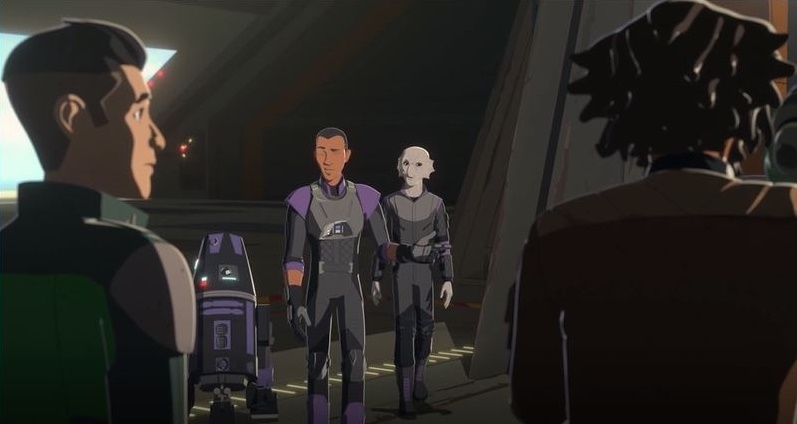
On the plus side, Yeager's brother is rather pleasant and charismatic. Not to the degree of the really cocky racer a few episodes back though. His co-pilot has little to do aside from a humorous moment or two with Neeku, as does his rather dark evil looking droid. It's amazing to see the stunningly dressed Guavian Death Gang this episode, whom Yeager's brother has a debt to and hold his co-pilot as ransom. They are menacing but, more than anything, super cool to look at. Super 'The Force Awakens' flashbacks seeing them!

I'm left also unsure what Captain Doza gains from this episode? He instigated Yeager's brother coming back and their brotherly rivalry to help bring money to the platform. I guess the betting made money? There was no proof that money came from anywhere else because of his plan.

Oh Brother ...

Death Squad! Awesome!

Yeager forgives ... WTF?

Rating: 6/10 - Brotherly rivalry can be thrilling but it falls a little flat and odd here for me, however, the Death Squad and the race itself really make up for the brotherly storyline.